
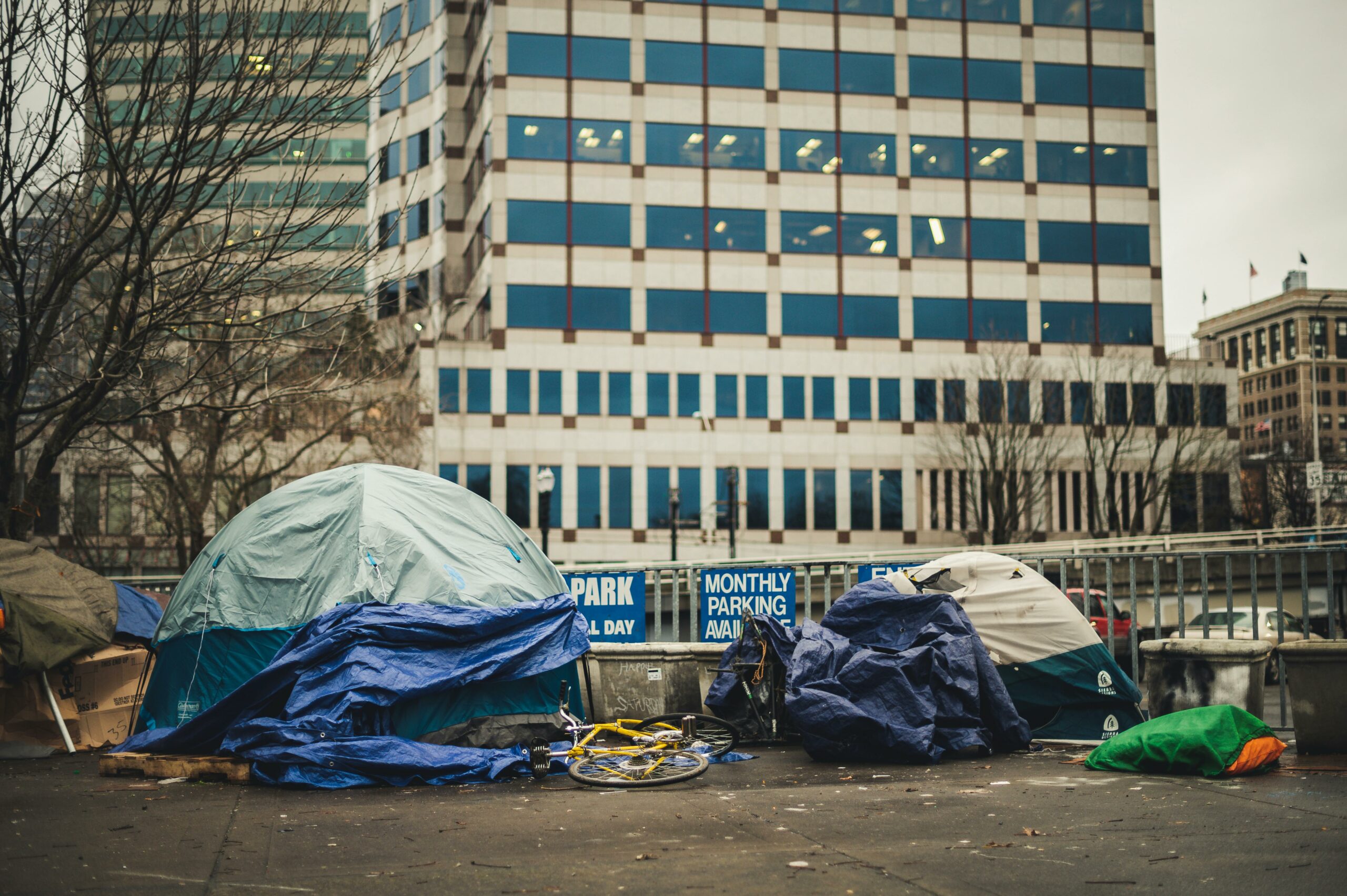
A little over a year ago, the Supreme Court held that a state law criminalizing homelessness was not unconstitutional in City of Grants Pass v. Johnson.[1] The Court found that even if there is no space available in a city’s homeless shelters, the city may still arrest and fine a person for public camping or sleeping on public property.[2] Since that decision, there has been a nationwide increase in cities and several states enacting public camping and sleeping bans.[3] North Carolina’s House Bill 781, introduced on April 7, 2025, proposes that the state join that trend.[4]
House Bill 781: A statewide ban on public camping and sleeping.
The bill would enact a statewide ban on public camping and sleeping, placing significant pressure on local governments to enforce the new law.[5] One provision grants private residents and business owners the right to sue their local government to compel enforcement of the law.[6] The bill appears to leave classification of the offense to the discretion of local governments, although they should try to conform penalties to those at issue in City of Grants Pass (up to $1,250 fine and 30 days in jail)[7] or passed by other cities since the City of Grants Pass decision (harshest: up to $1000 fine and 1 year in jail)[8] in order to avoid a constitutionality challenge.
The bill also states that if a local government lacks sufficient shelter space to house all homeless individuals within its boundaries, the governing board may vote to designate a piece of public property to be used for public camping and sleeping.[9] This would serve to confine the homeless population of a locality to a single encampment rather than being scattered across the area. While this may sound like an easy fix, the bill states that the designated property may only be used for one year,[10] and there are numerous health and safety requirements that a local government must be able to satisfy. A local government must (1) ensure the safety and security of people residing on the designated property, (2) maintain sanitation including access to clean and operate restrooms with running water, (3) provide access to behavioral health services, including substance abuse and mental health treatment sources, and (4) prohibit illegal substance and alcohol use on the designated property.[11]
Addressing unsheltered homeless populations in urban areas will be costly.
Taken as a whole, the bill would require significant funding, especially to address unsheltered homeless populations in larger cities like Charlotte and Raleigh. “Unsheltered” refers to “individuals residing in locations not intended for human habitation such as streets, cars, parks, and encampments.”[12] Being unsheltered may be the result of a lack of shelter space, but some choose not to reside in shelters for a variety of reasons, including safety concerns, inability to be sheltered with one’s partner, pet, or belongings, or remoteness of shelter location from one’s job or social network.[13] A study conducted in January 2025 revealed that out of the total homeless population of 2,415 in Charlotte/Mecklenburg County, there were 444 unsheltered individuals.[14] In Wake County, which covers Raleigh, 287 out of 1,258 homeless individuals were unsheltered in 2025, more than double the number of unsheltered individuals in 2024.[15] These statistics likely underestimate the true number of unsheltered homeless individuals.[16]
If a local government opts for simple enforcement of the ban, it will face increased law enforcement costs associated with arresting and jailing homeless people found camping or sleeping on public property. There would also be increased costs to house and feed those arrested while kept in jail. In addition, if a local government chooses this route but declines to fund alternative housing, law enforcement will have to arrest and jail the same unsheltered individuals over and over again. Homeless individuals threatened with jail time cannot be deterred from public camping and sleeping if shelters are full and they have nowhere else to go and no ability to simply raise themselves out of homelessness.[17] Fines imposed similarly have no deterrent effect if homeless individuals have no money to pay them. These penalties may actually have the opposite effect by keeping homeless individuals “stuck in a cycle of instability,” and as a result, less able to find housing and jobs and more likely to resort to public camping and sleeping.[18]
Setting aside designated property for public camping is also an expensive option since local governments must meet the various health and safety requirements listed in the bill.[19] The cost will also vary by locality based on the number of unsheltered individuals. For example, in Charlotte/Mecklenburg County, there would need to be set aside government property large enough to accommodate at least the 444 unsheltered individuals identified by the study,[20]while also providing adequate bathroom facilities, security, and various social services. Moreover, the encampments are only permitted temporarily, so local governments will be left scrambling to fund more shelters or alternative housing within the year. Under either option or a combination of the two, local governments will face the increased cost of defending themselves in court against injunctions if they fail to adequately enforce the new law.
Florida passed a similar statewide ban in 2024 with nearly identical provisions to NC House Bill 781.[21] The Florida legislature budgeted $30 million to help local governments enforce the ban and fund the establishment and operation of designated properties, but local officials have stated that it isn’t enough to effectively address the issue.[22]As of yet, the North Carolina legislature has not proposed any state funding to assist local governments in implementing the law if it were to be passed,[23] but the situation in Florida may serve as a predictor of what level of costs lie ahead, whether that burden is taken on by the state or forced on local governments.
North Carolina should seek more compassionate, long-term solutions.
Costs aside, homelessness is a serious issue deserving of the state’s attention, but is a statewide ban really the best solution? For one, criminalizing homelessness is extremely dehumanizing and stigmatizing. This rings especially true in those localities where there is insufficient shelter space to house everyone, and those left out face the risk of being arrested for simply having nowhere to go. To this point, the dissenting Justices in City of Grants Pass argued that the majority was permitting a status crime, a type of criminal law that is considered cruel and unusual punishment in violation of the 8th Amendment for punishing a person for their status/state of being in the absence of criminal conduct.[24] There are certainly much better uses for the criminal justice system than arresting and jailing people who haven’t engaged in any criminal conduct in the traditional sense of causing harm to other members of society.
In addition, if the North Carolina legislature is truly interested in pursuing such a costly endeavor, why not redirect the funds that will inevitably need to be raised to increase shelter capacity, build low-income housing, and expand social services to help raise people out of homelessness? The proposed statewide ban offers only temporary solutions: arresting and jailing unsheltered homeless people gets them off the streets for a while, but it doesn’t make them any less homeless when they’re released, and designated properties only consolidate the unsheltered homeless population of a locality for one year before it’s back to normal. While some of the services that would be offered on the designated properties are arguably a step in the right direction, neither provision under the ban offers a long-term solution to raising people out of homelessness.
For the time being, NC House Bill 781 has been tabled by the Senate, but that does not mean that it will never be passed.[25] The Senate may wait until a future session to take a vote once it is determined whether the state is willing and able to fund the bill. In the meantime, perhaps the threat of such drastic legislation will serve as a call to action for local governments to develop a long-term plan for decreasing unsheltered homeless populations.
[1] See 144 S. Ct. 2202 (2024).
[2] See id. at 2221–22, 2226.
[3] See Robbie Sequeira, Many More Cities Ban Sleeping Outside Despite a Lack of Shelter Space, Stateline (Jan. 27, 2025), https://stateline.org/2025/01/27/many-more-cities-ban-sleeping-outside-despite-a-lack-of-shelter-space/; see Sarah Michels, Homeless Camping Ban Appears to Die in NC General Assembly, for Now, Cicero Inst. (July 2, 2025), https://ciceroinstitute.org/news-media/homeless-camping-ban-appears-to-die-in-nc-general-assembly-for-now/.
[4] See H.B. 781, 2025 Gen. Assemb., Reg. Sess. (N.C. 2025).
[5] See id.
[6] See id. § 160D-917(h).
[7] See City of Grants Pass, 144 S. Ct. at 2213.
[8] See Sequeira, supra note 3.
[9] See H.B. 781 § 160D-917(c), (d)(1).
[10] See id. § 160D-917(c).
[11] Id. § 160D-917(c)(1)–(4).
[12] Unsheltered Homelessness in Mecklenburg County: Data, Insights, and Solutions, Charlotte-Mecklenburg Hous. & Homelessness Dashboard, https://mecklenburghousingdata.org/frontpage-article/unsheltered-homelessness-in-mecklenburg-county-data-insights-and-solutions/(last visited Oct. 14, 2025).
[13]See id.; See Daniel Soucy et al., State of Homelessness: 2025 Edition, Nat’l All. to End Homelessness (Sept. 4, 2025), https://endhomelessness.org/state-of-homelessness/.
[14] Point in Time Count Reveals Faces of Homelessness Amidst Growing Needs, Mecklenburg Cnty. (June 6, 2025), https://news.mecknc.gov/point-time-count-reveals-faces-homelessness-amidst-growing-needs.
[15] New Tools, Volunteers and Better Outreach Result in Most Accurate Homeless Count Yet, Wake Cnty. (May 6, 2025), https://www.wake.gov/news/new-tools-volunteers-and-better-outreach-result-most-accurate-homeless-count-yet.
[16] See id.
[17] See City of Grants Pass v. Johnson, 144 S. Ct. 2202, 2231 (2024) (Sotomayor, J., dissenting).
[18] See Sequeira, supra note 3.
[19] See H.B. 781, 2025 Gen. Assemb., Reg. Sess. § 160D-917(c)(1)–(4) (N.C. 2025).
[20] Point in Time Count Reveals Faces of Homelessness Amidst Growing Needs, supra note 14.
[21] See Fla. Stat. § 125.0231 (2024).
[22] See Terry Spencer & Kate Payne, Florida Enacts Tough Law to Get Homeless Off the Streets, Leaving Cities and Counties Scrambling, AP News, https://apnews.com/article/florida-homeless-ban-poverty-a70d27efb0ec5f41bfb3d6c2facc8f84 (last updated Oct. 1, 2024, 4:48 PM).
[23] See Michels, supra note 3.
[24] See City of Grants Pass v. Johnson, 144 S. Ct. 2202, 2234 (2024) (Sotomayor, J., dissenting).
[25] See Michels, supra note 3.


